Editor's note: Check back later Tuesday for photos and updates from the farewell flight festivities.
SAN FRANCISCO — It sure didn’t feel like a curtain call. But that’s what it was Tuesday morning at San Francisco International Airport as United Airlines bid farewell to its last Boeing 747.
United Flight 747 was scheduled to take off for Honolulu at 11 a.m. local time, departing from Gate 86 after a de facto party among those ticketed on what went into the books as United’s last-ever passenger flight on the 747.
All on board had booked the flight specifically to be on the last 747 departure, a special one-off flight scheduled by United in September to give the famous jumbo jet a proper send-off.
It’s a grand finale, no question,” United CEO Oscar Munoz said to USA TODAY from the jet’s upper deck just before takeoff. “It’s a fitting send-off in the most dignified way for the ‘Queen of the Skies’.”
Tickets for the 374-seat jet sold out in hours, despite one-way fares of $550 and up for the one-way flight to Hawaii.
“I had to be here,” said John Vanderford, 56, of Detroit, as he partied with other Flight 747 customers prior to boarding. “It’s the last 747 flight. I remember flying it as a kid, on this exact route — San Francisco to Honolulu."
Donald Trump’s commerce secretary, Wilbur Ross, is doing business with Vladimir Putin’s son-in-law through a shipping venture in Russia.
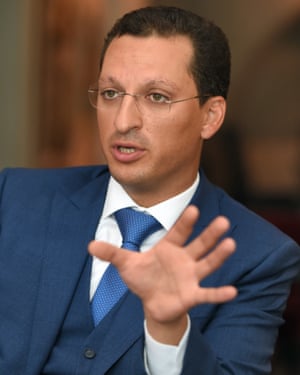
Leaked documents and public filings show Ross holds a stake in a shipping company, Navigator, through a chain of offshore investments. Navigator operates a lucrative partnership with Sibur, a Russian gas company part-owned by Kirill Shamalov, the husband of Putin’s daughter Katerina Tikhonova.
Ross, a billionaire and close friend of Trump, retained holdings in Navigator after taking office this year. The relationship means he stands to benefit from the operations of a Russian company run by Putin’s family and close allies, some of whom are under US sanctions.
Corporate records show Navigator ramped up its relationship with Sibur from 2014, as the US and EU imposed sanctions on Russians. The measures followed Putin’s aggression in eastern Ukraine and annexation of Crimea. Navigator has collected $68m in revenue from its Sibur partnership since 2014.
Ross, 79, has apparently faced little official scrutiny over the arrangement. He told a US ethics watchdog that he was keeping a pair of obscurely named holding companies, but did not specify whether he would also retain their interests in Navigator and its lucrative contract in Russia.
The Ross interests appearin the Paradise Papers, a trove of millions of leaked offshore files reviewed by the Guardian, the International Consortium of Investigative Journalists and other partners. They join established links between Ross and Russian finance that have raised questions over his selection by Trump to head the US Department of Commerce.
Analysts said the arrangement was troubling. Daniel Fried, an assistant secretary of state for European and Eurasian affairs under George W Bush, said Ross’s connection to “cronies of Putin” threatened to undermine US sanctions.
“I don’t understand why anybody would decide to maintain this kind of relationship going into a senior government position,” he said. “What is he thinking?”
What are the Paradise Papers? – video
Peter Harrell, a senior state department official under Barack Obama, who worked on sanctions against Russia, said: “I’m frankly surprised. Maybe I shouldn’t be, given that with this administration, there seems to be a Russian in every closet.”
Ross’s press secretary, James Rockas, said in a statement that Ross’s holding would not conflict with his government duties on trade and industry. “Secretary Ross recuses himself from any matters focused on transoceanic shipping vessels,” he said.
The disclosures come as inquiries intensify into Russian interference with the 2016 US election. Congress and Robert Mueller, the special counsel, are investigating possible collusion between Trump’s presidential campaign and Moscow. Ross has dismissed claims of collusion as “rumour and innuendo”.
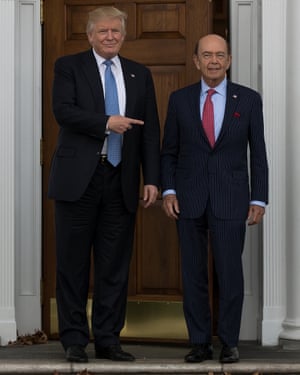
Donald Trump and Ross. Photograph: Drew Angerer/Getty Images
The involvement of Ross and Shamalov in the shipping venture dates back to 2011. That year, Ross’s investment firm, WL Ross, began buying into Navigator with an investment that gave him two seats on the company’s board. Meanwhile, in Moscow, Shamalov began investing in Sibur, which was formerly state owned.
By January 2012, having built up his holding in the Russian company, Shamalov, then 29, was made its deputy chairman. That summer, WL Ross took control of Navigator by buying a further $110m stake from the collapsed Lehman Brothers bank.
Shamalov is the son of Nikolai Shamalov, one of Putin’s oldest friends from St Petersburg, where Putin worked in the mayor’s office. He married Katerina in a secret ceremony in February 2013.
Later that year, two ships from Ross’s company began transporting liquefied gas out of Russia for Putin’s son-in-law’s firm under a decade-long contract initially worth $226m.
Towards the end of the year, Navigator went public on the New York stock exchange, its share price buoyed by the Sibur deal. WL Ross more than doubled its money, prompting Ross to boast in remarks to a convention that his firm had hit “a home run” by taking over Navigator.
Shamalov drastically increased his holding in Sibur in September 2014. He borrowed $1.3bn from the state-controlled Gazprombank – his brother, YuryShamalov, is the bank’s deputy chairman – and used this to buy a chunk of Sibur from Gennady Timchenko, who is under US sanctions. The US Treasury said in 2014 that Putin held investments in Timchenko’s oil-trading firm, which it denied.
Ross stepped down from Navigator’s board in November 2014. His replacement was Wendy Teramoto, then managing director of WL Ross. Teramoto has since resigned from the businesses to join the Trump administration as Ross’s chief of staff.
Shamalov insisted he had received no preferential treatment in the Sibur deal and had received his stake on strictly commercial terms.
Karen Dawisha, the director of Russian and post-Soviet studies at Miami University, Ohio, said it should be assumed that Putin benefited from the prosperity of companies run by his relatives and close associates.
“Shamalov is a very important member of Putin’s circle and there is no question that he is closely trusted,” said Dawisha. “He was not well trained for the job at Sibur, but he was well connected.” Shamalov has a law degree from St Petersburg State University, according to Sibur.
Shamalov stepped down as deputy chairman in 2015. He remains a director of Sibur.This year, he reduced his 21.4% stake in the company, which was worth about $2.85bn, to 3.9%. This was completed in April, while journalists were looking into Sibur’s connections to Ross. The reason for the sale was unclear.
Shamalov sold to Sibur’s main shareholder, Leonid Mikhelson. Mikhelson is Russia’s richest man, according to Forbes magazine, and CEO of the gas producer Novatek. The Obama administration twice imposed sanctions on Novatek, once in 2014 over Ukraine and again in 2016 as punishment for Moscow’s meddling in the US election.
The offshore commerce secretary
Under the Navigator-Sibur deal, two ships – the Navigator Libra and the Navigator Leo – began moving Sibur gas from the Russian port of Ust-Luga, west of St Petersburg, to Scandinavia and elsewhere in Europe. The partnership doubled to four ships this year, as Ross joined Trump’s administration. Invited to name the new vessels, Sibur christened them Navigator Luga and Navigator Yauza, after Russian rivers.
Corporate records show that the proportion of Navigator’s revenue coming from Sibur almost doubled between 2014 and 2015, even as Sibur’s owners complained of being shut out of financial markets due to sanctions.
Sibur has also received assistance from the Kremlin while dealing with Ross’s firm. In May 2014, a Russian government fund led a $700m investment in the Ust-Luga port, where Sibur has exclusive rights to ship liquefied gas. In December 2015, Sibur received a $1.75bn state loan repayable at a third of the market rate.
Rockas, Ross’s press secretary, tried to distance Ross from the Sibur deal with a series of statements that were contradicted by other sources. He said the Navigator-Sibur deal was signed in February 2012, before Ross joined the Navigator board. But Sibur’s annual report for that year said the deal was signed in March.
Rockas said Ross did not join Navigator’s board until 31 March 2012. But a press release filed to the Securities and Exchange Commission on 2 March that year said Ross was by then already on the board. In ethics forms filed this year, Ross estimated that his start date had been January 2012.
Rockas said: “No funds managed by WL Ross & Co ever owned a majority of Navigator shares.” But a press release issued by the company in August 2012 was titled “WL Ross Agrees To Acquire Majority Stake In Navigator”.
Navigator vessels also carried out extensive business with the Venezuelan state oil company PDVSA, records show, at a time when Venezuela’s government was cracking down on opposition. Trump imposed sanctions on PDVSA in August.
Rockas said Ross “has been generally supportive of the administration’s sanctions of Russian and Venezuelan entities.” He said Ross had never met Shamalov, Timchenko or Mikhelson.
The Paradise Papers detail a complex web of dozens of offshore investments that have been held by Ross, who publicly champions Trump’s campaign promise to “bring back” business to the US. Many use similar names and acronyms that are difficult to decipher.
The files show, for instance, that Ross is a shareholder in WLR Recovery Associates IV DSS AIV GP, a Cayman Islands investment vehicle. This is a shareholder and general partner of WLR Recovery Associates IV DSS AIV LP, another Cayman Islands entity, which is in turn a general partner of WLR Recovery Fund IV DSS AIV LP, a third Cayman firm, which is a shareholder in Navigator.
The WLR stake in Navigator is now worth about $179m, according to corporate filings, but it is not clear how much of this is held by Ross personally. When he joined the Trump administration, Ross declared holdings worth up to $10m in vehicles with interests in Navigator.
In a letter to the commerce department and Office of Government Ethics before taking office this year, Ross said he was retaining his interest in a handful of entities, including two that hold stakes in Navigator. The letter said some retained interests related to shipping but did not detail whether this included the subsidiaries that led to Navigator.
At the end of May, Ross sold a small holding in Navigator worth $15,000-$50,000, according to an ethics filing. But he appeared to retain other Navigator stakes.
Ross was not asked about his links to Putin’s family during his confirmation hearing by the US Senate. RichardPainter, the chief ethics counsel in George W Bush’s administration, said Ross had not made absolutely clear in his paperwork that he was retaining a stake in Navigator. “It is very difficult to figure out from the financial disclosure,” said Painter. “He should have sold off any and all interests.”
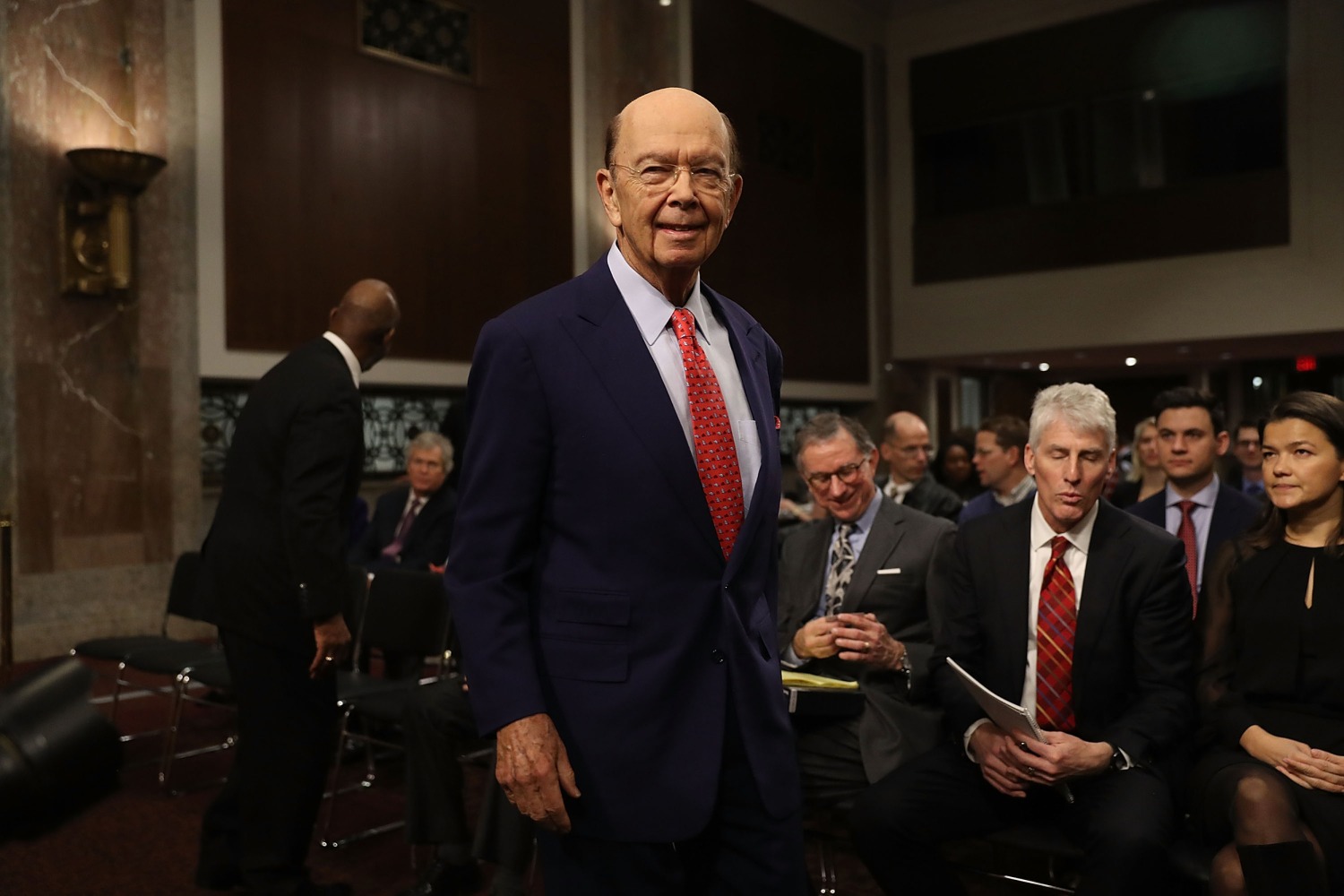
Ross testifies at his confirmation hearing in January. Photograph: Joe Raedle/Getty Images
Lloyd’s List, the authoritative shipping industry newsletter, said in January that Ross’s ethics disclosures suggested he was making a “clean cut” from Navigator by divesting from WL Ross. “Mr Ross’s apparent departure is to avoid conflict of interest,” it said, before quoting a remark made by Ross during his Senate confirmation hearing: “I intend to be quite scrupulous about recusal.”
Ross and the Russians
Ross built lucrative connections to Russian business during a 40-year career that banked him an estimated fortune of $2.9bn, making him comfortably the wealthiest member of Trump’s cabinet.
His private equity firm, WL Ross, earned him a reputation as a ruthless corporate raider. Ross took over bankrupt companies, turned them around by slashing costs, and sold them for large profits. An early critic of free trade, who profited from tariffs to protect US steelmakers, Ross has been deputised by Trump to fulfil the president’s populist campaign promise to overhaul international trade deals.
In 2014, Ross led a €1bn takeover of the Bank of Cyprus, a favoured destination for Moscow oligarchs seeking to store their wealth. The bank’s biggest shareholder at the time was the Russian billionaire Dmitry Rybolovlev. In 2008, as the US began to fall into a financial crisis, Rybolovlev bought a Florida mansion from Trump for $95m. The future president had paid $41m for it four years earlier.
Also invested in the bank takeover was the billionaire Russian industrialist Viktor Vekselberg. Vekselberg, who owns the world’s biggest collection of Fabergé eggs, attended the now infamous December 2015 dinner in Moscow for the Kremlin TV channel RT, where Trump’s future national security adviser Michael Flynn was photographed next to Putin.
Ross sat on the senior leadership team of Bank of Cyprus alongside Vladimir Strzhalkovsky, a former KGB colleague of Putin’s who is also on the board of several state corporations in Moscow.
And in 2015, while Ross was vice-chairman of the bank, its Russia-based businesses were sold off to Artem Avetisyan, a Russian businessman who had been appointed by Putin to lead an agency responsible for strengthening ties between the Kremlin and business.
Democratic senators wrote to Ross in February demanding that he disclose “the full extent of your connections to Russia”. Ross did not respond. The senators also lambasted the White House for refusing to provide answers to the questions before the vote confirming Ross.
Asked around that time whether Bank of Cyprus had any customers under US sanctions during his time there, Ross told CNN: “That’s a question that is very complicated to answer,” adding that he had never approved any such deals.
Transactions through the bank involving Paul Manafort, Trump’s former campaign chairman, are reportedly part of the federal inquiry into Russian interference in the 2016 US election.
Ross also entered Russian markets through other industries. After WL Ross’s 2005 takeover of VTG, Europe’s largest railcar leasing firm, the German company opened offices in Russia. Over the following years, VTG bought out other Russian firms in the sector, taking on thousands of railcars in the country. VTG’s chief executive, Heiko Fischer, eventually sat with Ross on the board of Navigator.
Five offshore entities in the Cayman Islands holding VTG stock were among some 50 linked to Ross and his firm in the Paradise Papers. The firms were handled by Appleby, a legal and accounting company. One leaked file said WL Ross was among Appleby’s top 20 clients by total billings.
Rockas, Ross’s press secretary, said: “Private equity firms have a responsibility to their investors to optimize corporate structures, and Secretary Ross has decades of experience that he is now using to benefit American workers.”
In May 2016, as Ross trod the campaign trail with Trump, his firm sold off the last of its holdings in VTG. The sale brought in about $420m for Ross’s firm, which had not disclosed how much it paid a decade earlier.
Ross and his wife, Hilary, own a Manhattan apartment, a home in the Hamptons and a house valued at $23m in Palm Beach, Florida. The house is a five-minute drive from Trump’s private club, Mar-a-Lago, where Ross accompanied the president during weekend visits in his early weeks in office.
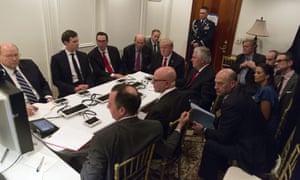
In April, Ross was pictured at Trump’s right hand inside a makeshift situation room at the club where the president monitored missile strikes against Syrian forces in response to the Assad regime’s latest use of chemical weapons. Ross later described the strikes as “after-dinner entertainment”.
Trump and his team monitor missile strikes in Syria in a ‘situation room’ at Mar-a-Lago. Photograph: Shealah Craighead/AP
On the day Ross was nominated to the cabinet by Trump in November last year, he and Navigator executives including David Butters, the chief executive, dined together in a private room at Manhattan’s Gramercy Tavern restaurant. “Your interest is aligned to mine,” Ross reportedly told Butters. “The US economy will grow, and Navigator will be a beneficiary.”
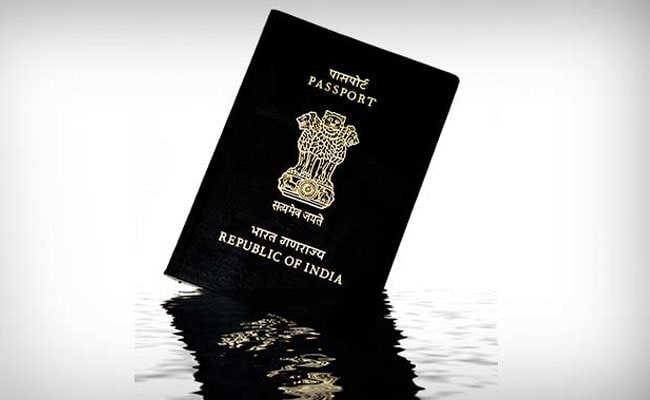
Historically, the top 10 most powerful passports in the world were mostly European, with Germany having the lead for the past two years. Since early 2017, the number one position was shared with Singapore, which was steadily going up, it said.
India ranked 75th in the global passport ranking, three notches better than the previous time
Singapore: Singapore has the world's "most powerful" passport, according to a global ranking topped for the first time by an Asian country with India figuring at 75th position, three notches better than its previous ranking.
According to the 'Global Passport Power Rank 2017' by global financial advisory firm Arton Capital, Germany is ranked second, followed by Sweden and South Korea in third place.
Paraguay removed visa requirements for Singaporeans, propelling Singapore's passport to the top of Passport Index' most powerful ranking with a visa-free score of 159, the company statement said.
Historically, the top 10 most powerful passports in the world were mostly European, with Germany having the lead for the past two years. Since early 2017, the number one position was shared with Singapore, which was steadily going up, it said.
"For the first time ever an Asian country has the most powerful passport in the world. It is a testament of Singapore's inclusive diplomatic relations and effective foreign policy," said Philippe May, managing director of Arton Capital's Singapore office.
India, which was listed 78th last year, has improved its ranking, figuring at 75th position with a visa-free score of 51.
Coming in at last place on the list is Afghanistan, ranked 94 with a score of 22, followed by Pakistan and Iraq at 93 with a score of 26, Syria at 92, having a score of 29 and Somalia at 91 with a score 34.
"Visa-free global mobility has become an important factor in today's world," said founder and president of Arton Capital Armand Arton at the recently held Global Citizen Forum in Montenegro.
"More and more people every year invest hundreds of thousands of dollars in a second passport to offer better opportunity and security for their families," Mr Arton added.
While Singapore quietly climbed the ranks, the US passport has fallen down since President Donald Trump took office. Most recently Turkey and the Central African Republic revoked their visa-free status to US passport holders, the statement said.
Passport Index has become the most popular interactive online tool to display, sort and rank the world's passports.
The index ranks national passports by the cross-border access they bring, assigning a "visa-free score" according to the number of countries a passport holder can visit visa-free or with visa on arrival.
Wilbur Ross, the commerce secretary in the Trump administration, shares business interests with Vladimir Putin’s immediate family, and he failed to clearly disclose those interests when he was being confirmed for his cabinet position.
Ross — a billionaire industrialist — retains an interest in a shipping company, Navigator Holdings, that was partially owned by his former investment company. One of Navigator’s most important business relationships is with a Russian energy firm controlled, in turn, by Putin’s son-in-law and other members of the Russian president’s inner circle.
Wilbur Ross Latest Trump Official to Fall Under Scrutiny for Russia-Relations1:59
Some of the details of Ross’s continuing financial holdings — much of which were not disclosed during his confirmation process — are revealed in a trove of more than 7 million internal documents of Appleby, a Bermuda-based law firm, that was leaked to the German newspaper Süddeutsche Zeitung. The documents consist of emails, presentations and other electronic data. These were then shared with the International Consortium of Investigative Journalists — a global network that won the Pulitzer Prize this year for its work on the Panama Papers — and its international media partners. NBC News was given access to some of the leaked documents, which the ICIJ calls the “Paradise Papers.”
Wilbur Ross, picked by President-elect Donald Trump to serve as his commerce secretary, arrives to testify at his confirmation hearing in front of the Senate Commerce Committee on Capitol Hill on January 18, 2017 in Washington. Joe Raedle / Getty Images file
Overall, the document leak provides a rare insight into the workings of the global offshore financial world, which is used by many of the world’s most powerful companies and government officials to legally avoid paying taxes and to conduct business away from public scrutiny. More than 120 politicians and royal rulers around the world are identified in the leak as having ties to offshore finance.
The New York Times reported Sunday that the documents also contain references to offshore interests held by Gary Cohn, Trump's chief economic adviser, and Secretary of State Rex Tillerson. There is no evidence of illegality in their dealings.
Ross' widespread financial interests
In Ross’s case, the documents give a far fuller picture of his finances than the filings he submitted to the government on Jan. 15 as part of his confirmation process. On that date, Ross, President-elect Donald Trump’s choice for commerce secretary, submitted a letter to the designated ethics official at the department, explaining steps he was taking to avoid all conflicts of interest.
That explanation was vital to his confirmation, because Ross held financial interests in hundreds of companies across dozens of sectors, many of which could be affected by his decisions as commerce secretary. Any one of them could represent a potential conflict of interest, which is why the disclosures, by law, are supposed to be thorough.
“The information that he provided on that form is just a start. It is incomplete,” said Kathleen Clark, an expert on government ethics at Washington University in St. Louis. “I have no reason to believe that he violated the law of disclosure, but in order … for the Commerce Department to understand, you’d have to have more information than what is listed on that form.”
Ross, through a Commerce Department spokesperson, issued a statement saying that he recuses himself as secretary from any matters regarding transoceanic shipping, and said he works closely with ethics officials in the department “to ensure the highest ethical standards.”
The statement said Ross “has been generally supportive of the Administration’s sanctions of Russian” business entities. But the statement did not address the question of whether he informed Congress or the Commerce Department that he was retaining an interest in companies that have close Russian ties.
In his submission letter to the government, Ross pledged to cut ties with more than 80 financial entities in which he has interests.
Wilbur Ross testifies before a Senate Commerce, Science and Transportation Committee confirmation hearing on his nomination to be commerce secretary at Capitol Hill on January 18, 2017 in Washington. Carlos Barria / Reuters file
Ross’s apparent ethical probity won praise, even before he signed the divestment agreement, from both sides of the political aisle.
'Our Committee Was Misled'
The documents seen by NBC News, however, along with a careful examination of filings with the Securities and Exchange Commission, tell a different story than the one Ross told at his confirmation. Ross divested most of his holdings, but did not reveal to the government the full details of the holdings he kept.
In his letter to the ethics official of the Commerce Department, Ross created two lists: those entities and interests he planned to get rid of and those he intended to keep. The second list consisted of nine entities, four of which were Cayman Islands companies represented and managed by the Appleby law firm, which specializes in creating complex offshore holdings for wealthy clients and businesses. The Wilbur Ross Group is one of the firm’s biggest clients, according to the leaked documents, connected to more than 60 offshore holdings.
The four holdings on the list of assets that Ross held onto were valued by him on the form as between $2.05 million and $10.1 million. These four, in turn, are linked through ownership chains to two other entities, WLR Recovery Fund IV DSS AIV L.P. and WLR Recovery Fund V DSS AIV L.P., which were listed in Ross’ financial disclosure prior to confirmation, but were not among the assets he declared he would retain. According to an SEC filing, those entities hold 17.5 million shares in Navigator, which constitutes control of nearly one-third of the shipping firm.
“You look at all of these names,” Clark said, referring to the financial entities, “and they actually look like a code. And what we actually have to do is find — in a sense — a code that decrypts what these names mean and what these companies actually do.”
She said the way the companies were listed was deliberately vague. “I would say this gives the appearance of transparency,” she said, referring to Ross’s disclosure documents. “It’s sort of fake transparency in a sense.”
EXCLUSIVE: Commerce Sec. Ross Has Financial Ties to Putin-Connected Business2:07
The Office of Government Ethics, which is responsible for executive branch oversight, approved Ross’s arrangement, and it was left almost entirely unchallenged by the Senate.
Sen. Richard Blumenthal, D-Conn., said members of Congress who were part of Ross’ confirmation hearings were under the impression that Ross had divested all of his interests in Navigator. Furthermore, he said, they were unaware of Navigator’s close ties to Russia.
“I am astonished and appalled because I feel misled,” said Blumenthal. “Our committee was misled, the American people were misled by the concealment of those companies.” Blumenthal said he will call for the inspector general of the Commerce Department to launch an investigation.
And a cursory look at Navigator’s annual reports reveal an apparent conflict of interest. Navigator’s second-largest client is SIBUR, the Russian petrochemical giant. According to Navigator’s 2017 SEC filing, SIBUR was listed among its top five clients, based on total revenue for the previous two years. In 2016, Navigator’s annual reports show SIBUR brought in $23.2 million in revenue and another $28.7 million the following year.
The business relationship has been so profitable that in January, around the time Ross was being vetted for his Cabinet position, Navigator held a naming ceremony for two state-of-the-art tankers on long-term leases to SIBUR.
The Kremlin's inner circle
One of the owners of SIBUR is Gennady Timchenko, a Russian billionaire on the Treasury Department’s sanctions list. He has been barred from entering the U.S. since 2014 because authorities consider him a Specially Designated National, or SDN, who is considered by Treasury to be a member “of the Russian leadership’s inner circle.”
The Treasury Department statement said that Timchenko’s activities in the energy sector “have been directly linked to Putin” and that Putin had investments with a company previously owned by Timchenko, as well as access to the company’s funds.
Daniel Fried, who was the State Department sanctions coordinator under President Barack Obama, said the connection to Timchenko’s interests should have raised alarm bells.
“I would think that any reputable American businessman, much less a Cabinet-level official, would want to have absolutely no relationship — direct, indirect — … with anybody of the character and reputation of Gennady Timchenko,” Fried said. “I just don’t get it.”
Another major SIBUR shareholder is Leonid Mikhelson, who, like Timchenko, has close ties to the Kremlin. One of his companies, Novatek, Russia’s second-largest natural gas producer,was placed on the Treasury’s sanctions list in 2014.
Included in the Appleby documents are details of an internal discussion that resulted in the law firm dropping Mikhelson as a client in 2014, over concerns regarding his financial affiliations.
“I would say to anybody who asked,” said Fried, “treat SDNs as radioactive. Stay away from them.”
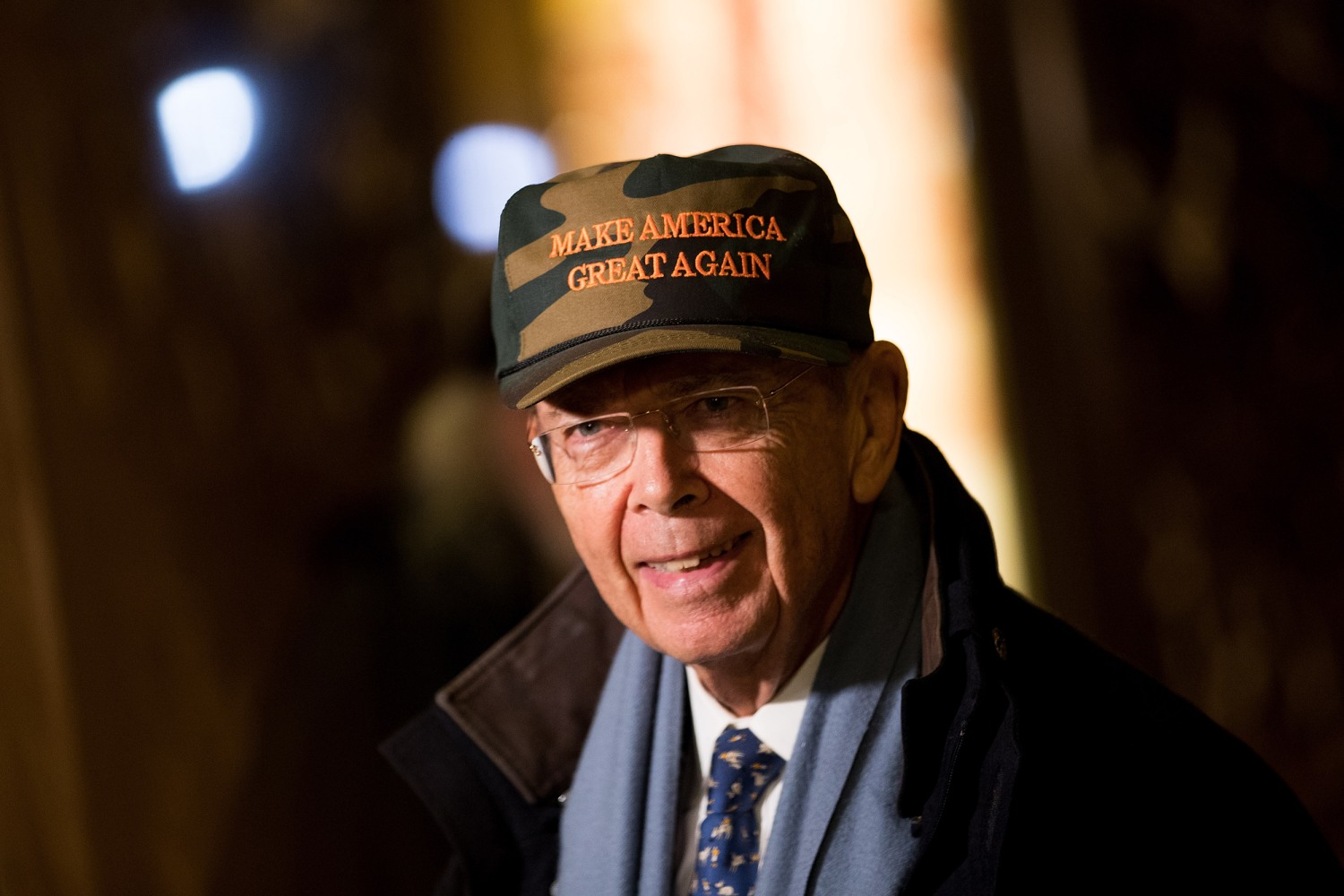
Wilbur Ross, President-elect Donald Trump's choice for Commerce Secretary, wears a 'Make America Great Again Hat' as he speaks briefly to reporters at Trump Tower on November 29, 2016 in New York City. Drew Angerer / Getty Images file
A third shareholder of SIBUR – and deputy chairman of the board – is Kirill Shamalov, husband of Vladimir Putin’s daughter, Katerina Tikhonova. After the wedding, Shamalov’s meteoric rise to wealth led him to own as much as 21.3 percent of SIBUR’s stock until April, when he sold off around 17 percent for a reported $2 billion.
“It’s a new generation which is currently being prepared and groomed... to inherit whatever power and wealth Putin's team has accumulated over the past years,” said Vladimir Milov, a former deputy energy minister in Putin’s government who is now working with the opposition.
Milov also said companies like SIBUR are often the way sanctioned Kremlin insiders have to keep doing business despite restrictions.
The Commerce Department statement said Ross never met Timchenko, Mikhelson, or Shamalov. It said he was not on the board of Navigator in March 2011 when the ships in question were acquired, or the following February when the charter agreement with Sibur was signed. It said Sibur was not under U.S. sanctions now or in 2012. The statement said Ross was on the board of Navigator from March 30, 2012 to 2014, and that no funds managed by his company ever owned a majority of Navigator’s shares.
But as The Guardian reported Sunday, other public documents suggest a different story. A Navigator news release on March 2, 2012, said that Ross was already on the board at that point, and Sibur's annual report for 2012 said the deal with Navigator was signed in March. In addition, Ross' company issued a news release on Aug. 10, 2012, saying that the company had agreed to acquire a majority stake in Navigator.
Fried said he has no doubt of the connections between SIBUR and the Kremlin.
“If any senior official of the U.S. government, much less a Cabinet secretary … had any business dealings with sanctioned individuals, direct or indirect,” he said, “I would be appalled.”
Richard Painter, the chief White House ethics lawyer during the George W. Bush administration, said there needs to a close examination of whether Ross’ testimony to the Senate violated perjury laws. Painter also said Ross must recuse himself from all Russia-related matters because of the SIBUR connection.
“Secretary Ross cannot participate in any discussion or decision-making or recommendation about sanctions imposed on Russia or on Russian nationals when he owns a company that is doing business with Russian nationals who are either under sanctions or who could come under sanctions in any future sanctions regime,” Painter said. “That would be a criminal offense for him to participate in any such matter.”